Sunday, November 23, 2014

Witch-slapped: Macbeth's fall from grace

1. Why do people who are not "evil" take the first step into evil? What, for instance, is involved in taking that first step "down the primrose path to the everlasting bonfire" (Macbeth, 2.3)? What are the consequences of the individual choosing evil (particularly the internal consequences)? Use examples from the text to support your opinion.


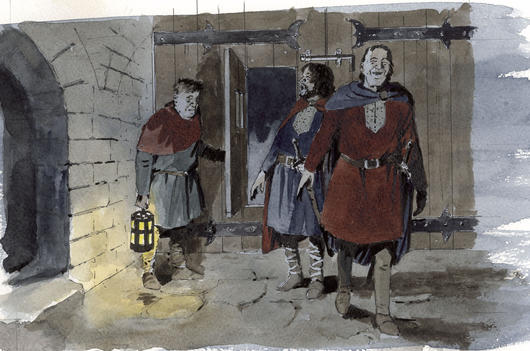
     Most people don't wake up one day in the attempt to change their life completely. Someone who has led a decent, non-evil life, usually won't convert to being evil without an outside force to drive them. Take peer pressure for example. It is a scenario many of us have been in where one or more people are pressuring you into doing something you don't want to. This doesn't mean they are pressuring you into something bad, or evil, but something you don't want to do. Whether its jumping off of a cliff, petting a horse, or doing crystal meth for your first time, it is peer pressure if you would normally not want to partake in the action. The reader can see Macbeth giving into peer pressure from his wife, lady Macbeth. She is pressuring him, verbally, to kill his King. Macbeth is worried about the consequences and is unsure about this decision initially. But in the end gives into his wife's nagging. Essentially, he is giving into peer pressure.

     The consequence of doing evil things, if you get caught, is usually time in prison. However, guilt can eat you alive. Especially in a case where a good person goes bad. When someone isn't used to being evil they might feel especially shameful or guilty. Whereas a serial murderer, who is used to taking lives, would feel fine. Macbeth goes a bit crazy after he kills Duncan. After many mixed reactions to the crime he committed, he started to lose it. The guilt of the murder, and the desire for power led Macbeth to want to kill even more people, within reason of course. These mixed emotions caused him to take the life of his own friend, Banquo. In our society these situations might not get so out of hand. 


Sunday, November 9, 2014


1)
Jose Davila (b. 1974, Mexico)

Topologies of Belief
2011

Piezography print on photo based paper

2) The Work above is contemporary. It is from a Mexican artist who is still active today, and has exhibits all over the world. The exact location of these photos is unknown, 

3) Here we see a new treatment of traditional photography. Davila calls these works "cut outs" and they have gotten increasingly popular over the past few years. Essentially, as it can be inferred by the name, Jose prints these photos (it is unknown if he has taken them himself) and cuts out the parts of his choice to alter the picture. 

4) In these pictures, weather they are original or not, Davila went for a black and white theme. Shape, and space seem to be the driving force of his works as the alterations that he makes are large and empty. He uses the blank space he created to his advantage as it brings attention to the surrounding area of the photo. As for composition, his cut outs are made, more or less, in the middle area of the photographs. Leaving the area around the center uncut gives the work a sense of completeness, and wholeness, rather than emptiness. Personally, I feel this is inventive, and creative, as is most contemporary art. Although, it does not surpass traditional art. Traditional art takes time, craftsmanship, and skills that this work does not require. 

5) I believe the purpose of this work was simply to turn these old, unattractive photos into contemporary works of art. Now I could try and deduce the exact cultural and political socio-economic value of the pictures, but that would take away from what it really is. I can see that these photos are likely from mexico as they include a few men that look "potentially Mexican" and the scenery matches that from which i have seen myself in my travels to mexico. But aside from this, the blank space he has cut out creates a displacement of your view. You cannot look at what used to be in the blank space, so you are forced to accept it as a solid white shape. Your eyes are drawn to the surrounding area since it is darker than the white area. It forces you to pay attention to details that you might not have notice were there if the photo was never altered. On the other hand the blank space adds a pop to the photo. It makes the viewer a bit surprised to see that there is nothing in the white space, and it makes people question the work. What used to be here, and what was its significance? My only conclusion is that Jose is trying to show the lack of relevance everything has in life. When he takes things away, the photo still functions normally, as if the cut out was never even there in the first place.